

One Library - All of India


PROLOGUE:
THE FIRST LIBRARY IN THE WORLD
"There resided a venerable and learned monk who was more than ninety years old, the Guru and Mahapandita Rahulasribhadra. Raja Buddhasena of Magadha honored this Guru and four other Panditas, and about seventy venerable ones (monks)."
— Dharmasvamin, 1235 CE (Translator: George Roerich)

The very first record we have of a library in the human world has been traced to an Indian monastery called Nalanda located at what is currently the eastern Indian state of Bihar. Nalanda is also considered to be the world's first residential university, a sort of medieval Ivy League institution home to 9 million books that attracted 10,000 students from across Eastern and Central Asia. They gathered here to learn medicine, logic, mathematics and buddhist principles from some of the era's most revered scholars.
As the Dalai Lama once stated: "The source of all the [Buddhist] knowledge we have, has come from Nalanda."
In the more-than seven centuries that Nalanda flourished, there was nothing else like it in the world. The monastic university predates the University of Oxford and Europe's oldest university, Bologna, by more than 500 years. What's more, Nalanda's enlightened approach to philosophy and religion would help shape the culture of Asia long after the university ceased to exist.

The ancient Indian medical system of Ayurveda, which is rooted in nature-based healing methods, was widely taught at Nalanda and then migrated to other parts of India via alumni. Other Buddhist institutions drew inspiration from the campus' design of open courtyards enclosed by prayer halls and lecture rooms. And the stucco produced here influenced ecclesiastical art in Thailand, and metal art migrated from here to Tibet and the Malayan peninsula. Aryabhatta, considered the father of Indian mathematics, is speculated to have headed the university in the 6th Century CE. "We believe that Aryabhatta was the first to assign zero as a digit, a revolutionary concept, which simplified mathematical computations and helped evolve more complex avenues such as algebra and calculus,"
NDLI CALENDAR: ANCIENT INDIA NDLI CALENDAR: ANCIENT INDIA NDLI CALENDAR: ANCIENT INDIA
Interestingly, the monarchs of the Gupta Empire that founded the Buddhist monastic university were devout Hindus, but sympathetic and accepting towards Buddhism and the growing Buddhist intellectual fervour and philosophical writings of the time. The liberal cultural and religious traditions that evolved under their reign would form the core of Nalanda's multidisciplinary academic curriculum, which blended intellectual Buddhism with a higher knowledge in different fields.

In its lifetime, different invaders destroyed Nalanda University three times. The first destruction was caused by the Huns under the reign of Mihirakula. The second destruction came during the 7th century by the Goudas. The third attack on the Nalanda University was by the Turko-Afghan general Bakhtiyar Khilji during the year 1193 and proved to be the most lethal.
And this is the story of just the first torched library and demolished institution.
India's knowledge legacy is mired in war, riots, religious differences, power-struggles, gender disparity and 300 years of colonial rule. Of what is left of our knowledge heritage that was not looted, burnt or plundered, a lot is also lost in translation as it was passed down through word-of-mouth, sometimes even encoded in fables and stories.

However, we persist, as is the cycle of life.
Standing amidst a fast globalizing world, today's India is young, hungry and always eager to learn. In fact, our country has been heralded the world over as an epitome of frugal innovation, our 1.4 billion population has survived multifarious challenges to still produce some of the brightest minds in every subject across the globe. But we have some dire roadblocks ahead.
A TALE OF TWO INDIAS
Higher Education in India: Vision 2030:
“... if India were to create this additional capacity [HEI Enrolment: 7Cr in 2010 to 14Cr in 2030] through increase in brick and mortar institutions alone, it would have had to build 6 universities and 270 colleges each and every month in the last 20 years -impossible to achieve with India’s limited resources...”
– Page 11, From 2013 to 2030: The Nuts and Bolts of Transformation, FICCI Higher Education Summit 2013

With 1 million people turning 18 every month, India has the largest youth population in the world. That's more than 444 million children in need of an education.
Around the time the narrative of this story starts, Indian education was going through a strange dichotomy. We were the 4th largest producer of doctorates (after US, Germany and UK) contrasting at the same time, as also being the largest population of adult illiterates in the world (300 million+).
Even with our 800 universities, 35,000 colleges and 7,500 stand-alone institutions, the demand for just higher education institutions far outstripped the country’s existing infrastructure.
In a joint survey by the Ministry Of Human Resource and Development [MHRD] and EY, it was identified that India would need to build 6 Universities and 270 colleges each and every month in the last 20 years to meet her demands - a feat that would have been greatly challenging for any country, and was statistically impossible for India with her current resources.
The rest of this document, charts a historic journey of learning, unlearning, fighting, adapting, transforming, evolving and observing the birth and growth of an idea that could transform India - the largest-youngest country in the world.
CHAPTER I: Birth of a Vision

1. The Proposal
It was a year that gave India a new Prime Minister, a Nobel laureate and also witnessed the country successfully putting a satellite into orbit around Mars.
It was also the year India was declared polio free by WHO, the year Make In India was launched, the year of the Kashmir Floods, the year the Indian Stock Market Crossed the Rs 100 Lakh Crore M-Cap and the year we lost Khushwant Singh.
The year was 2014. And at the very least, a lot was happening with the 1.4 billion people of, by and for the Democratic Republic of India.
On the education front, the new government that had swept the country came out with a fiery manifesto and a dream for some paradigm shifts using new-age technologies, especially India's record-breaking digital penetration to build, amongst other things, a National e-library - One library, for all of India.
In this backdrop, at a historic meeting, the President, Prime Minister and Minister of Human Resources and Development* [MHRD] of India had held an All-IIT- Director's meet, to get together with the heads of the country's premier technical institutions in a bid for transformative National Mission in Education projects using the disruptive potential of technology under its NMEICT scheme.
The selected bid was IIT Kharagpur's proposal to build the National Digital Library of India - a 24X7, open-access, multi-lingual, multi-modal, single window platform that will democratise learning - One library, for all of India.
NDLI was conceived as the central component in a radical rethinking of education in India.
A movement that would bring varied, multilingual content at the fingertips of all learners from all places. A movement that can only succeed through the participation of the entire nation. A nation - that lives mostly in its villages, where imparting and accessing quality education is beset by poverty, inaccessibility and lack of physical infrastructure.
With over 100 million content from premier institutions - NDLI today is a single window access to the world for, though not limited to this demographic. Connected to other National Mission in Education initiatives like SWAYAM it also hopes to address the acute shortage of teachers and educational infrastructure, which have been the reality in rural India for a long time.
Charged with the hopes of the government, policy-makers, educators, librarians, technocrats and allies from around the world, NDLI is our knowledge beacon to the younger generation that should give them open access to a world-class education.
1.1 Vision, Mission, and Motto
THE VISION:
The National Digital Library of India is being built as India's Knowledge Asset - one that will form the backbone of e-learning in India. It will have a wealth of content ranging from Engineering to Music, Medicine to Literature, Culture to Commerce and everything in between. It will be across all platforms and is envisaged to become the key driving force behind research, innovation and the knowledge economy of India.
NDLI VISION STATEMENT:
Build up National Digital Library of India as a National Knowledge and Cultural Asset- The key driving force for Education, Research, Cultural heritage, Innovation, and knowledge-sharing in India.
THE MISSION:
IIT Kharagpur started implementing the vision for One library for All of India from around April 2015. At the time of writing, NDLI houses 100 million content out of which >75 million is open access. To empower learners, the NDLI also utilizes the concept of ‘National Licensing’ whereby otherwise subscribed content is available for free as paid for by the nation.
NDLI MISSION STATEMENTS:
To create a 24X7-enabled integrated ubiquitous digital knowledge source
To protect and preserve India’s cultural, academic and scientific heritage
MOTTO:
The motto for National Digital Library of India has always been
Open and Inclusive.
NDLI has been built as a central, open-access knowledge bank that can feed structured courses which can be customised by edupreneurs, schools, Universities and academia at large - making is always open.
The platform embodies inclusivity by enabling any learner of any age to access any subject to any degree of proficiency irrespective of location and geography. It is browsable in the 10 most spoken Indian languages, it houses content in over 300+ world languages and can provide support for the whole spectrum of learners from school students to high-end research to career upskilling.
NDLI also houses DEEPAK (Disability Education and Engagement Portal for Access to Knowledge) - a first of its kind disability knowledge portal that provides information on Blindness & Low Vision, Deaf & Hard of Hearing, Autism Spectrum Disorder and more.

1.2 A CLARION CALL FOR ALL GATEKEEPERS

PHASE 0: PROOF OF CONCEPT
[SEP 2014 - MARCH 2015 ]
The concept of developing the National Digital Library (NDL) was conceived during the discussion with Prof. P.P. Chakrabarti, Director, IIT Kharagpur and Hon'ble Minister of MHRD, Govt. of India in the month of June, 2014 and subsequent discussion with Dr. B. Sutradhar, Librarian, Central Library, Prof. P.P. Das, Department of Computer Science and Engineering and Prof. P.P. Chakrabarti, Director, IIT Kharagpur, a proposal was made and submitted to Ministry of Human Resource Development (MHRD).

The objective of the pilot project of National Digital Library (NDL) was to integrate all the existing digitized contents across educational institutions of the nation to provide single window access to the different group of users of our country.
With the objective, several discussions and meeting were held for designing a standards Metadata schema for different types of learning e-content to be used for NDL project.
The Metadata summarizes basic information about data, which can make finding and working with particular instances of data easier.
For example, author, date created and date modified and file size are examples of very basic document metadata. Having the ability to filter through that metadata makes it much easier for someone to locate a specific document. Based on the discussion and meeting, a preliminary draft for NDL Metadata Schema (ver 1.0) was prepared by Dr. P.K. Bhowmick based on Dublin Core (DC) and IEEE LOM by incorporating the inputs from Prof. P. P. Das, Prof. Sudeshna Sarkar, Dr. P. S. Mukhopadhyay, Dr. P.K. Bhowmick and Dr. B. Sutradhar.

Dr. P. K. Bhowmick had presented NDL metadata (ver 1.0) schema in the meeting held at IIT Delhi on 23 April, 2015, where Prof. P.P. Das, Joint. PI of the NDL Project, Dr. Jagdish Arora, Director, INFLIBNET, Prof. B.D. Gupta, National Coordinator of INDEST-AICTE Consortium, Prof. Uma Kanjila, IGNOU, New Delhi, Dr. B. Sutradhar Co-PI of NDL Project, Dr. S.K. Jalal and Mr. S.G. Roy from Central Library, IIT Kharagpur and Mr. S. Banerjee, CSE, IIT Kharagpur were present.
In the brainstorming session held at IIT Kharagpur during May 21-22, 2015, Prof. P.P. Chakrabarti, Director, IIT Kharagpur, in his welcome address emphasized the mission and vision of NDL to all the members present in the meeting and also requested to bring out Manual for NDL Metadata Schema (ver-2.0) to accommodate different types of digital contents.
Based on the discussions and feedbacks from the expert members like Prof. Uma Kanjilal, Dr. P.S. Mukhopadhay, Dr. Jagdish Arora, Prof. P.P. Das, Prof. A. Basu, Prof. Sudeshna Sarkar, Dr. P.K. Bhowmick, Dr. B. Sutradhar, Dr. Sandip Chakraborty, Mr. Yatrik Patel, Mr. Abhisekh Kumar and Dr. S. K. Jalal, Metadata Manual (ver. 2.0) was drafted incorporating all important elements from metadata standards like Dublin Core, IEEE LOM, LRMI Standards and MPEG 7 into NDL.
The drafted version 2.0 of NDL Metadata Schema has been verified thoroughly by Prof. Uma Kanjilal and Dr. P.S. Mukhopadhyay.
Prof. Kanjilal has specially contributed the part of Educational Metadata based on LRMI and MPEG 7 for multimedia metadata.
PHASE 1: NDL PILOT PROJECT
[APR 2015 - SEP 2017 ]
During the infrastructure phase of the project, the core NDLI team had two key areas of focus:
Building the technical infrastructure for NDLI using IITKGP's extensive knowledge and network.
Baselining with the other digital libraries of the world to learn, share, grow.
Prof. Partha Mukhopadhyay, Prof. Uma Kanjilal (IGNOU), Dr. Jagdish Arora (Director, Inflibnet) helped us come up with the first framework of Digital Libraries worldwide.

The first thing we noticed from the framework was- none of the developed countries had a National Digital Library for the purpose of Education.
Next to note would be India's unique language and personalisation requirements as an inclusive, open platform with the dream to democratise education for a country with 387 living and 11 extinct languages.
With these two critical questions, we went on global quest to seek knowledge, guidance, learnings and insights from other Digital Libraries, similar ICT Projects, Digital Librarians, Data Architects, Engineers, Scientists, Researchers, Advisors, Consultants, IP Lawyers, International Ambassadors and various trans-disciplinary subject matter experts across India as well as from around the world.
As a first pass, we learnt a couple of things about our global counterparts:
Developed Countries: Do not need National Digital Library to supplement education infrastructure – their key focus is hence on the Culture & Heritage domain
Developing Countries: Do need large scale cost-effective education; but mostly do not have expertise and resources for it
India is uniquely poised with need for digital education and have the expertise and resources for it
National Libraries of several countries have digital interface. However due to copyright issues repository volume of freely available full–text contents is negligible.
Many leading academic libraries (like Stanford University Library) provide excellent resources for research exclusively in-house
Meanwhile, back at home, NDLI herself was unfurling into a multi-lingual multi-modal totem not just for, but from India. In the global context, not only were we received with open arms, but with unprecedented excitement in terms of learning and knowledge-sharing.
It started dawning on us that the libraries around the world were waiting to hear from India - and NDLI was becoming the platform through which India speaks for herself - to highlight, offer and share her own cultural, spiritual, academic and scientific heritage on her own terms.
NDLI received resounding response and successfully completed its Pilot Phase (Phase-I) well before its scheduled completion period of March 2018. The Ministry of Human Resource Development therefore decided to foreclose the project on 30th September 2017 and launched the Phase II of the project from 1st October 2017.
KEY TAKE-AWAYS FROM NDLI PILOT PHASE:

THE CONFIDENCE OF A NATION: India too can pull off large-scale ICT projects successfully and within time to get its masses connected
GLOBAL ACCOLADES FOR NDLI: Within just two years of development, NDLI had earned International repute as a major Digital Library project in the field of Knowledge Engineering in terms of its content, context and technology infrastructure
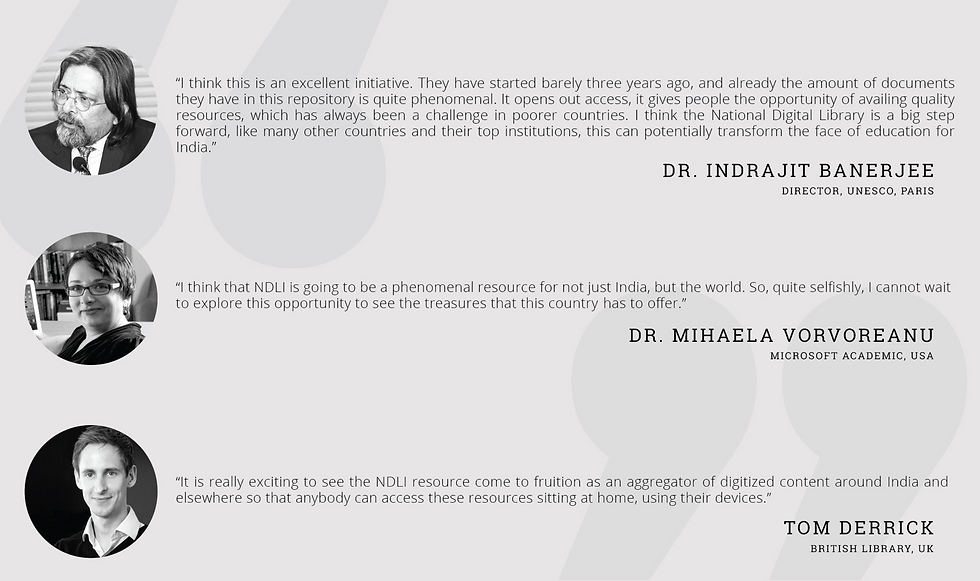
KNOWLEDGE ECONOMY IN 2017: Developed nations wanted to collaborate with NDLI for knowledge sharing and developing nations wanted to learn from the NDLI model to build their own digital learning infrastructures
ALL FOR ONE LIBRARY AND ONE LIBRARY FOR ALL OF INDIA: As a large-scale multi-disciplinary project that needs active collaboration between various skill sets, success greatly depends on highly motivated teams and effective cross-functional collaboration driven by clear vision - this includes not only project staff, but also various trans-disciplinary consultants, domain experts as well as outsourced vendors
WITH GREAT PROMISE COMES GREAT RESPONSIBILITY: For Phase 1, the Ministry had set certain tangible targets for the project. However, by surpassing all expectations in every domain, NDLI had amassed such great momentum that by Phase 2, we were being asked to set our own targets.
IS IT A LIBRARY ? : As our vision broadened, we were enlightened of the multiverse of possibilities that a digital library could evolve into. The future of libraries could be a library, a museum and a laboratory all rolled into one VR space. Our greatest limit was our own imagination!
_______________________ End of Chapter 1 __________________________________
CHAPTER 2: WHERE TO BEGIN?
2.1 ARCHITECTING THE VISION
"Reinventing the wheel is to be scrupulously avoided if a system of this magnitude is to be put in place... It will also be necessary to design the portal in such a way that it sustains the interest of the learner... "
-Approach statement from NDLI Mission document, 2014
2.1.1. METADATA MODEL
The NDLI metadata envelope is built to tackle 3 key challenges unique to the challenge of democratising education in India:
WIDE CATEGORY OF RESOURCES
OPENNESS OF THE REPOSITORY
ENORMITY OF SCALE
Guided by DR. PARTHASARATHI MUKHOPADHYAY(Associate Professor, Dept. of Library & Information Science, University of Kalyani) , we had assessed that the integration of domain-specific metadata schemas and interoperability standards in a discovery system may lead to an array of user-centric information services required for a pan-India project like NDLI.
NDLI was being envisaged to be a huge repository of digital content from varying domains and content categories. Variation in content category motivated the exploration of different metadata standards to define the ultimate metadata schema for the National Digital Library of India.
Based on the variation in contents, metadata schema in NDLI has been categorised into three classes:
Generic Metadata: This set of metadata describes general attributes of the contents. Generic metadata includes contributor, identifier, date, language, subject etc. This set of metadata fields have been adopted from Dublin Core metadata standard.
Educational Metadata: This set of metadata describes the educational attributes of the resources and helps in enumerating properties of the contents relevant to teaching-learning process. This metadata set includes educational level, type of learning material, educational use etc. This set of metadata has been adopted from Learning Resource Metadata Initiative (LRMI).
Thesis Metadata: Dissertation or thesis related metadata fields are described with this set of metadata. It includes metadata fields like researcher, advisor, degree etc. Shodhganga thesis metadata standard has been used to represent this metadata set.
As we were considering the best framework for NDLI's specific interoperability needs, we also started to run into various kinds of aggregation issues.
How we tackled the aggregation challenges on quality, automation, embargos and copyrights follow in the consequent chapters, but based on our research, we began by integrating 3 widely used metadata standards to build the NDL envelope.
DUBLIN CORE: The Dublin Core vocabulary, also known as the Dublin Core Metadata Terms (DCMT), is a general purpose metadata vocabulary for describing resources of any type. It was first developed for describing web content in the early days of the World Wide Web.
We hence used Dublin Core to identify generic content on NDLI.
LRMI: The LRMI specification is a collection of classes, properties and concept schemes for markup and description of educational resources. This vocabulary is designed to be used alongside other resource description vocabularies such as those provided by DCMI, Schema.org and other standards.
We hence used LRMI to identify educational content on NDLI
SHODHGANGA: Shodhganga by INFLIBNET (Information and Library Network) is India's national repository of research papers housing over 5,00,000 research papers from premier institutions and across disciplines. It runs on D-Space, which is an open source repository software package typically used for creating open access repositories for scholarly and/or published digital content.
We hence used Sodhganga as our base schema for research content on NDLI
The reader should note here, that these are broad schematics that we used as our baseline, and the prime metadata schema that we have been constantly developing since then has evolved further with the best of various other additions from IEEE , MARC21 and the like.
Once completed, we hope to have achieved a national edu-tech asset that will greatly enable knowledge access and discovery tailored for Indians as well as a more advanced communication framework for knowledge sharing globally, powered by India.
2.1.2 HARDWARE AND SOFTWARE MODEL
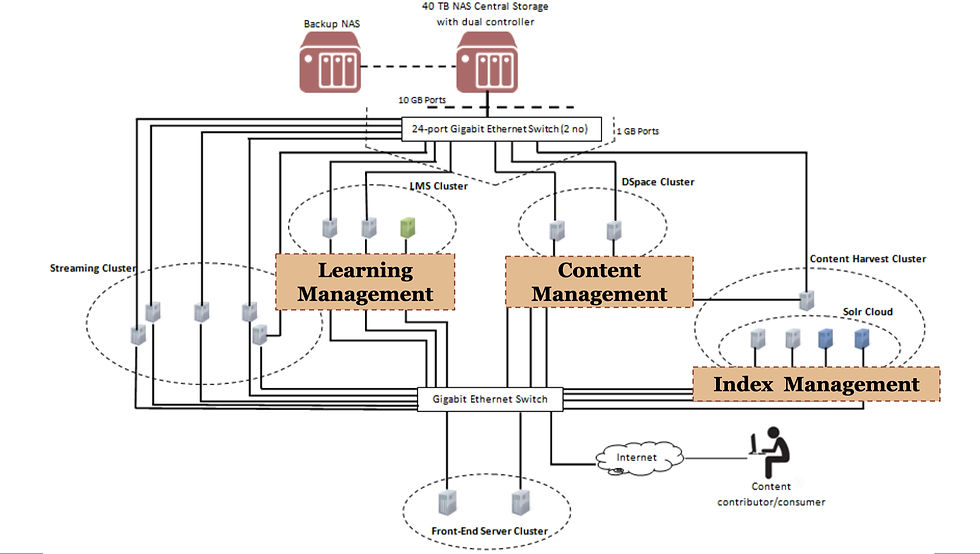
HARDWARE:
SERVER | NETWORKING SOFTWARE REDUNDANCY OF FAILS | LOAD BALANCE - 200 requests together|
SOFTWARE :
From a service perspective, the overall model of NDLI was conceptualized in a 3-tiered manner where services were added in each tier.

The bottom-tier (Digital Repository or DR) caters to basic Authoring and Acquisition Services through content creation and borrowing. Authoring services deal with content creation whereas acquisition services deal with content borrowing.
The middle layer, termed Digital Library or DL catered to the two important Dissemination Services: content search and content access.
The outer layer was built to support services like Multi-faceted Interface, Multi-lingual Search and Personalized Learning.
2.1.3. CURATION AND INGESTION MODELS
DIVERSE METADATA SCHEMA AND FORMATS:
Around 2015, before the release of open-source Large Language Models [LLMs] like ChatGPT, aggregation of content was still largely happening in silos - metadata schemas - should you think about them as trainee digital librarians, did not have a common language, and each catered to a specific need.
![The Elephant in the [metadata] room](https://static.wixstatic.com/media/c18bbe_10f13c9854be48adbfc6cdca635cb833~mv2.png/v1/fill/w_980,h_533,al_c,q_90,usm_0.66_1.00_0.01,enc_avif,quality_auto/c18bbe_10f13c9854be48adbfc6cdca635cb833~mv2.png)
In the absence of universal metadata standards, our initial method was schema to schema translation - some of the metadata fields could be mapped directly, the rest had to be checked and inputted manually.

Using this method, we were managing to curate about 300 odd pieces of content in a month.
This was obviously not very scalable, as it was taking a human resource about 30 mins to curate one document against all our required metadata fields, resulting in about 15-16 pieces curations per day.
So we started automating the metadata curation process.
Within 6 months we managed to scale our productivity by almost 100X by implementing a semi-automated curation workflow. By now we were curating 30,000 pieces of content in a month.
The current metadata extraction toolkit developed by NDLI includes:
Automatic metadata extraction workflow
Syntactic metadata extractor - Author name, ISBN, Publisher, dates etc
Subject Classification
Table of content extractor
Wikification for keyword extraction
Learning resource metadata
Toolchain for metadata extraction

2.1.4. OUTREACH AND AWARENESS MODELS
THE FIRST CHALLENGE: Knowledge Community Awareness and Acceptance towards NDL
A National Digital Library would require content inputs from multiple knowledge partners across the country - and for every discipline. So even though we had a proof-of-concept model, we still had the mammoth task ahead of us to establish partnerships with education institutes, research institutes, other libraries, eduprenuers, and various other forms of knowledge repositories to harvest metadata and populate the NDL.
In the beginning, it was a chicken or egg situation so as to speak.
We needed quality content befitting a national scale to get users, and on the other hand, we needed a strong base of users befitting a national scale to covince further content providers to join the NDLI.
We hence began our outreach efforts by reaching out to knowledge institutions for two parallel purposes:
AWARENESS AND REGISTRATION OF USERS
AFFILIATION AND ONBOARDING OF KNOWLEDGE PARTNERS
NDL Awareness in Workshops
One of the initial outreach initiatives we took was to introduce the concept, product , usage and benefits at national tech consortiums hapenning in India at the time - like the 11th INDEST-AICTE Annual Meet which was held at IISER Mohali from 29th - 30th Apr, 2015.
Feedback from the workshop made us realise that we need workshops for not just product but also technical awareness for our potential partners and content providers.
That is to say it was not just answer who, what, why and where - institutional librarians, tech support staff, professors also required more knowledge about how to harvest their institutions's metadata or sign-up all their students en-masse to NDL.
This gave rise to the NDLI Institutional Digital Repository (IDR) workshop model where the NDLI team would first explain the need, scale and impact of the project and then conduct a more hands-on technical training session with the stakeholders to enable them to integrate with the NDLI network.
Institutional Digital Repository (IDR) Workshops:

Our first consolidated national-level outreach effort under the NDL banner can perhaps be traced back to our first IDR (Institutional Digital Repository) Workshop titled National, East-I which was held at IIT Kharagpur, from 15th-17th Jun, 2015.
The first IDR Workshop that we had conducted at IITKGP was a 3 day program with over 120+ educational institutions from all over India. These workshops were structured with the following objectives:
Get the Big Idea accepted by the content partner
Inspire the content partner to join hands both as content provider as well as user
Enable the content partner to integrate with NDLI through knowledge transfer (IDR Training programme)
Help content partner in actual execution of the content harvesting through tech support

Over the course of the next few years, [2015 - 2018] the NDLI outreach team conducted over 30+ workshops training 2,500+ librarians and educators on the utility, usage and upkeep of Institutional Digital Repositories integrated with NDLI.

Over time, our workshops evolved into multi-disciplinary agendas we travelled the length and breadth of the country in an effort to spread awareness, onboard knowledge partners and enable students, teachers, libraries and learners on and about the National Digital Library of India.
NDLI User Workshops:
What initially began as NDLI awareness in various University workshops soon evolved into full-fledged NDLI User Workshops as our outreach gained momentum.
Our first stand-alone NDLI User workshop was an eye opener.
On 21st Oct 2016, Prof. Partha Pratim Das (Co-PI, NDLI) addressed about 300 students at Jamia Millia Islamia - India's premier Institute renowned for innovation and research excellence. Upon delivering our usual lecture on the need, use and vision for NDLI we recieved some strong feedback from the students that made us re-think the entire user interface of NDLI.
The student asks were direct and simple, all you guys are saying is great but:
Are there question papers on the national exams on the portal?
Are there solution papers for my subject?
In video content, are there tutorials for UPSC, SSC, RRB, JEE, NEET, CLAT?
We realised that students, who are our primary target users need the National Digital Library to function more as a service than just a repository.
Our succesive User Workshops at Pondicherry University in the South, NPTEL-MOOCs workshop in the East, MSU in the west, all had similar feedback.
This consistent feedback from students - who are our ultimate end-users gave us the realisation that :
Standing in the 21st century, it is not enough for a digital library to just have a vast amount of content, it is crucial to integrate reader-friendly completeness from the ground-up to make the platform relevant to the maximum number of learners.

FEEDBACK INCORPORATION FROM USER WORKSHOPS - BUILDING FOR READER-FRIENDLY COMPLETENESS:
Based on user feedback, the strategic question for the NDLI team really boiled down to - Pull or Push?
Should our library work on a pull model where we focus on openness and the learner navigates as, what and when she chooses?
Or should our library focus on a push model, where we focus on learner groups and build collections based on her specific learning needs and different stages?
Our priority being democratizing education before cultural/heritage curation, this led to a deeper focus towards curation for students. On 1 January 2018, NDLI appointed Dr Pijush Maiti and shortly after, Mr. Avik Mukhopadhyay to lead the NDLI content team. Under their able leadership and decades of STEM research and teaching experience, NDLI soon came up with some original learning assets of its own.
One of the most requested content from Indian students being solved question papers for the national entrance examinations, the team set about to create NDLI TUTOR - knowledge assets that did not just give out rote solutions (which are anyway available on other platforms - sometimes for a fee) but provided analysis of each problem statement, alternative solutions to the same problem, MCQ elimination strategies as well as related reading materials for these papers.

The NDLI User Workshops are an integral part of not just our awareness and outreach model, but also a crucial pillar of our feedback and improvement process even today. These workshops have really helped us connect with our end-users, learners and extended stakeholders who have continuously helped us stay grounded, offer more value and be more inclusive and open as a platform.
Public Library Workshops:
India has one of the largest public library networks in the world. However, the Public Library System in India despite having great potential, lacks an organized system due to the lack of a central structure. Public libraries are a State subject under the Constitution of India (Entry 12, State List).
Consequently:
There is no single national public library system.
Each state is responsible for establishing, funding and administering its own network.
The Government of India plays a facilitating role through policy initiatives and financial assistance rather than direct administration.
As a result, the distribution of public libraries is highly uneven across the country. States with long-standing library legislation and stronger public library movements have much denser networks than others. Our tryst with the Public Library system of India was a mixed bag of experiences and learning.
Team NDLI was invited to an Indian Public Library Movement [IPLM ] conference by Dr. Basheerhamad Shadrach, who was serving as the Asia co-ordinator for the World Wide Web Foundation, heading an initiative called Alliance for Affordable Internet (A4AI). In our eagerness to raise awareness about NDLI at an otherwise packed event, we had requested a projector and a microphone during the breakfast session for day two! What ensued was a talk that went on for 45 mins and an introduction with the P.N. Panicker foundation. In subsequent years, as we were looking to to build a South Regional Centre under the leadership of Dr. Vignesh Sornamohan, NDLI had allied with with the P.N. Panicker Foundation for their 25th National Reading Month initiative.
As NDLI grew in knowledge and capacity, our interactions with public libraries around the world opened our eyes to how public libraries can function as third spaces, and serve much larger roles in societies. As up-skilling centres, as experiential hub cum creche facilities, as public memory projects, to run programs on assisted living and awarenss - but more on this in later chapters.
The NDLI Outreach Ecosystem quickly developed into a multi modal, multi-platform and multi-disciplinary project that not only took us to every corner of the country, but various parts of the world.
CHAPTER 3: PROTOTYPE GOES LIVE
THE LAUNCH OF NATIONAL DIGITAL LIBRARY OF INDIA:
Dedicated to the service of the nation
The date 19th June, 2018, marked an auspicious turning point for education in India with the launch of National Digital Library of India by Shri Prakash Javadekar, Hon’ble Minister of HRD.
At the event, which took place at Vigyan Bhawan, New Delhi, on National Reading Day, and was attended by eminent library professionals, technology experts, policy makers, educators, journalists and an enthusiastic audi- ence of learners, the HRM said, “People should be in the habit of learning. There was a time when I would visit various public libraries and spend the whole day poring over books”. He then went on to elaborate on NDLI’s role in remediating the issue of access. “Access to quality educational resources is the right of every Indian citizen” said the Hon’ble Minister to resounding cheers at the event. He added that this initiative will greatly aid the government’s commitment towards ‘Padhe Bharat Badhe Bharat’ - a mission to educate all of India by enabling every learner with access to knowledge and academic resources.
Dr. Mahesh Sharma, The Minister of State (Independent Charge) and Culture, reminisced about his childhood and the difficulties he faced in locating learning content. He thanked National Digital Library of India for addressing that challenge by enabling students of today with instant access to quality educational resources, anytime and anywhere, “India is one of the largest consumers of mobile phones in the world. The country is moving towards a Digital India”. Speaking on the National Virtual Library of India, he added that together NDLI and NVLI can contribute towards leaving a mark on the global stage, “NVLI can take India’s culture, knowledge and heritage to not just every corner of India, but take the nation’s hitherto hidden knowledge and represent that before the World”. Speaking on India’s ‘Unity in Diversity’ policy, he added that National Digital Library of India, with its multilingual database and interface, was an important step forward in realizing this vision.
Prof. Partha Pratim Chakrabarti, Principal Investigator of NDLI and Director, IIT Kharagpur spoke on National Digital Library of India’s contribution towards driving international digital copyright policy. A repository of metadata hosting various kinds of content, including rare resources – NDLI is committed towards maintaining a healthy relationship between contributors and reposito- ries across India and the World in the context of copy- right. “In terms of the bigger picture, the government of India is trying to provide a new format for education where the highest and the best quality education can be received by everybody, anywhere in the country. And in this whole big picture, the National Digital Library is trying to play its role”, said Prof. Partha Pratim Chakrabarti at the inauguration.
3.1
WORKSHOPS:
Institutional Digital Repository (IDR) Workshops
Public Library Workshops
User Workshops
Copyright Workshops
Library Automation and Management Workshops
Edupreneurship Workshops
EVENTS:
NATIONAL EVENTS
INTERNATIONAL EVENTS
NEWSLETTERS
Press Releases
Social media campaigns
II Architecting the Vision
1 Metadata Model
1.1 NDLIVirtualMetadataManual
2 Hardware and Software Models
3 Curation and Ingestion Models
4 Outreach & Awareness Models
4.1 IDRTrainingPackage
TRYST WITH COPYRIGHT
With every new development came a new set of challenges. Digitization opened up a whole new subject of patents, trademarks and copyrights. We were dealing with vast amounts of data daily and we soon discovered that when it comes to knowledge sharing, not only were the students, teachers and librarians unaware of existing legalities, the situation was far more complicated as these laws vary greatly by geography, and India as a country was yet to consolidate its laws and policies.
16MAY’16 – Satyajit Ray archives
One of our prized collections, legendary filmmaker Satyajit Ray's "Kheror Khata" or Red note books was available for free access through the NDLI portal and mobile app. Containing the auteurs' hand-written notes, this priceless piece of content faced infringement when our team received news that the books were being downloaded and sold in Bangladesh in 2017! We had to block the print option on the pdf immediately and put. a watermark on every page :(
11MAY’17 – ECDL Foundation
We received rights violation alerts from one of our European content providers which further made us realise that to execute our vision for a ubiquitous digital knowledge resource, we first need to lay a strong legal foundation in terms of copyright to prevent misuse and infringement of such vast reserves of content
17MAY’17 – DLI
Over 160+ scanned books in the archives of our content partners DLI (Digital Library of India) attracted noticed for alleged breaches of copyright leading to the temporary shutdown of the entire website and the consequent quarantining of over 5Lakh rare books from NDLI.

These led to our call for a National Workshop on Copyright Issues for Digital Libraries. Attended by librarians from over 100+ premier institutions from every state of India, the two-day workshop saw animated debates, accounts from librarians about the copyright dilemmas faced in their own institutes - laying the foundation for what was soon to be become a historic document - the first Copyright Guide for digital libraries in India vetted by our country's leading IP lawyers and officiated by the Indian government.
Our global efforts culminated into an International Workshop on Knowledge Engineering for Digital Library Design held between 25-27th October, 2017 in collaboration with UNESCO


Comments